
Table of Contents
A garage door spring serves as the central force that offsets the full weight of the door, allowing controlled lifting and lowering during every cycle. High tension within the spring system supports smooth operation for both manual and automated movement. When spring integrity weakens, overall system balance is affected, leading to unstable motion and increased strain on connected hardware.
Spring failure also places added load on the garage door opener, which can reduce system reliability and restrict safe access. Understanding how spring tension supports daily operation helps property owners recognize the safety risks associated with wear and sudden breakage. Professional evaluation at the first sign of imbalance supports secure movement and long-term garage door performance.
What Causes Garage Door Springs to Break Under Tension
Garage door springs store a tremendous amount of mechanical energy that allows the door to open and close smoothly. Both torsion springs and extension springs are engineered to withstand a limited number of operating cycles, with one cycle defined as a full opening and closing sequence. Over time, repeated use weakens the metal and leads to eventual failure.
Although spring failure is unavoidable over the long term, environmental exposure and system strain can accelerate the breakdown process. Professional inspections help identify developing weaknesses before a sudden break occurs and reduce the likelihood of an unexpected system shutdown.
The Role of Tension in Garage Door Function
Spring tension is what allows a heavy garage door to feel manageable during operation. The tension is precisely calibrated to counterbalance the door’s weight so the lifting system remains stable and controlled.
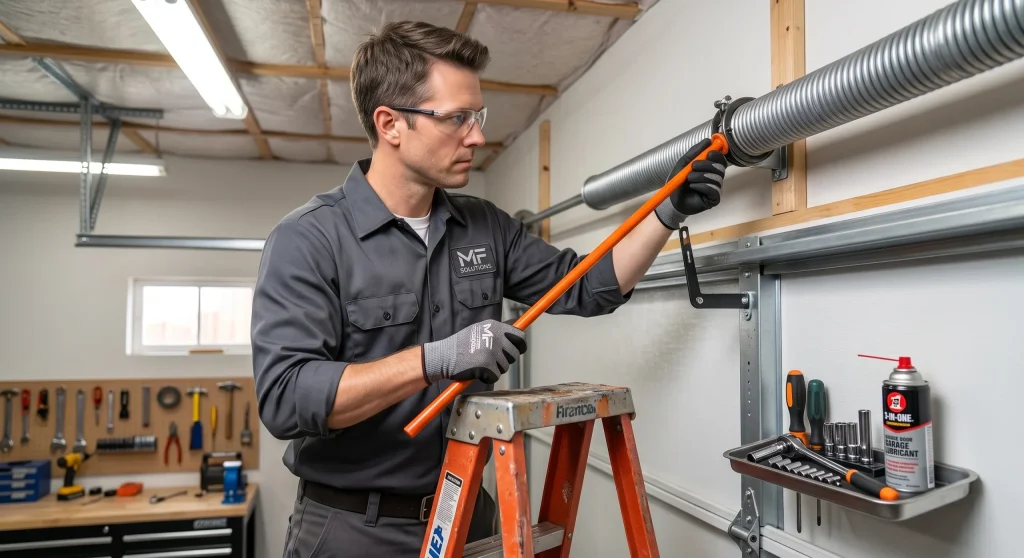
In torsion spring systems, the springs are mounted on a steel shaft above the door. As the door closes, the shaft rotates and stores energy inside the spring coils. When the door opens, that stored energy is gradually released to lift the door in a controlled motion.
This balance allows the garage door opener to guide movement rather than carry the full weight of the door. When tension weakens or becomes uneven, smooth operation is disrupted, and system stress increases across cables, tracks, and lifting hardware.
Common Wear and Tear Issues for Springs
Garage door springs experience constant stress during daily operation. Over time, visible wear tends to appear before a full break occurs. Recognizing early wear allows service to be scheduled before a system failure develops.
Common wear indicators include:
- Small gaps are forming between spring coils
- Springs appearing stretched or deformed
- Visible rust or corrosion on the metal surface
Once a spring breaks, replacement becomes the only safe option. Early detection during professional service helps avoid emergency repair situations and limits additional strain on connected hardware.
Environmental Factors Affecting Garage Door Spring Lifespan
Local climate plays a major role in how long garage door springs remain functional. Humidity, rainfall, and rapid temperature changes contribute to corrosion and metal fatigue. Moisture exposure promotes rust formation, which weakens spring coils and increases the risk of sudden failure under load.
Heavier doors also shorten spring lifespan because they place greater mechanical demand on the lifting system during every cycle. When climate exposure and door weight combine, spring degradation can occur more rapidly than expected. Regular professional maintenance helps counter these environmental effects and supports safer long-term operation.
For a deeper safety-focused breakdown of failure risks and replacement timing, explore our blog “How Dangerous Is a Broken Garage Door Spring—and When Should You Replace It?” for additional insight into spring behavior under extreme tension.
Immediate Effects of a Broken Garage Door Spring
When a torsion spring fails, the first indication is often a sudden, extremely loud bang caused by the rapid release of stored mechanical energy. The force behind that sound comes from the high tension the spring was holding during normal operation. Many homeowners mistake the noise for something unrelated because of how sharp and abrupt it is.
Once the spring breaks, the garage door immediately loses its lifting support. Without spring tension, the door becomes extremely heavy and difficult to control. This sudden loss of balance creates a serious safety hazard and leaves the door unusable until professional service restores proper function.
What Happens When the Spring Snaps
When the spring fractures, its tension is released instantly. With torsion systems, a visible gap typically appears in the coil where the metal is separated. While the metal shaft holds the broken spring sections in place, the lifting cables connected to the drum immediately lose tension.
As a result, the door’s full weight is no longer counterbalanced. The door may remain stationary, drop suddenly, or become stuck in place. At that point, the system requires precise re-tensioning with specialized equipment to restore proper balance. This process involves advanced handling procedures and must only be performed by trained technicians.
Safety Concerns for Homeowners in Niles, Illinois
A broken spring creates an immediate safety threat. The garage door can shift without warning, and any attempt to move it manually exposes individuals to serious risk. High-tension components remain under stress even after failure.
Major safety risks include:
- Sudden downward movement of the door without warning
- Severe injury from direct contact with collapsed components
- Additional system damage caused by forced operation
- Hand and arm injuries from handling broken hardware
Operating the door in any manner after a spring failure significantly increases danger. The safest response is to keep the area clear and request professional service without delay.
Impact on Garage Door Operation
The garage door system depends entirely on spring tension to function correctly. When the spring fails, the opener no longer has the mechanical support needed to lift the door. The motor may run, but the door will not move or may attempt to lift briefly before stopping.
Repeated attempts to use the opener under these conditions place excessive strain on the motor and internal drive components. This often results in opener failure, compounding the original problem. In many cases, the door remains stuck in either the closed or partially open position until the spring is replaced.
To better understand how early warning symptoms develop before a failure occurs, review our blog “Warning Signs Your Garage Door Spring Is About to Fail” for additional technical guidance on identifying spring deterioration before a breakdown happens.
Identifying a Broken Garage Door Spring
Recognizing a broken garage door spring becomes easier once you understand the visible and performance-related warning signs. While a door that suddenly feels heavy is a strong indicator, a careful visual check often provides clear confirmation. Early identification helps prevent sudden system failure and reduces safety risks.
The most noticeable visual sign is a visible separation in a fractured torsion spring. Knowing whether your system uses torsion or extension springs also helps pinpoint where failure is most likely to appear.
Visual Signs That Indicate a Problem
Several visible conditions clearly signal spring failure and confirm that replacement is required. A broken spring cannot be restored to safe operation and must be replaced by a trained technician.
Common visual warning signs include:
- Visible separation in a torsion spring with a distinct gap between coils
- Elongated or hanging extension spring along the side track
- Loose or slack lift cables near the bottom brackets or pulleys
Any of these conditions indicates a serious structural imbalance within the lifting system.
Functional Symptoms of a Broken Spring
Performance-related symptoms often appear before visible confirmation. One of the most common indicators is a garage door that suddenly feels extremely heavy when lifted manually. Without a proper spring counterbalance, the full door weight is no longer offset, increasing mechanical strain across the lifting system. Angi’s wiring and safety system guide explains that opener connections and safety sensor configurations require precise electrical routing and verified specifications, since improper setup frequently leads to operational and safety failures.
Performance-related symptoms often appear before visual confirmation. One of the most common signs is a door that suddenly feels extremely heavy when lifted manually. Without the spring counterbalance, the door’s full weight is no longer offset. Angi’s wiring guide shows that the connections for the opener and the safety sensor require proper electrical routing and specifications.
Additional functional indicators include:
- The opener begins lifting but quickly stops
- The motor operates without lifting the door
- The door closes with excessive speed
- The door stalls partway during movement
Operating the system under these conditions increases mechanical strain on connected components and creates a significant safety risk.
When to Consider Garage Door Spring Repair vs Replacement
In most cases, a broken spring requires full replacement rather than repair. Springs that have fractured or suffered advanced metal fatigue cannot be safely restored through adjustments. Replacement ensures proper balance, stable lifting force, and long-term system reliability.
Use the following general guidelines when evaluating service needs:
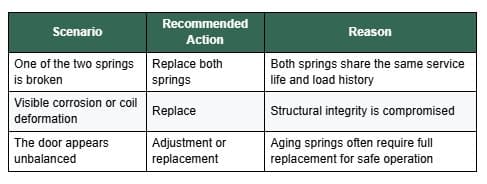
Replacing both springs at the same time maintains balanced tension, reduces uneven wear, and helps avoid repeated system failure shortly after initial service.
For a detailed safety-focused explanation of why professional service is critical during spring failure, review our blog “Why Professional Garage Door Spring Replacement Is Essential for Safety” for additional insight into proper replacement procedures and risk reduction.
How Broken Garage Door Springs Are Repaired Safely
A broken garage door spring creates a serious safety risk that requires immediate professional attention. These components operate under extreme tension, and improper handling can lead to severe structural damage and life-threatening accidents. For that reason, garage door spring repair is not suitable for untrained handling.
Safe repair depends on specialized equipment, technical training, and precise tension control. Professional service ensures the damaged spring is removed, replaced, and balanced correctly so the full garage door system can return to safe operation.
Specialized Equipment Used During Professional Spring Repair
Garage door spring replacement requires purpose-built tools designed specifically for high-tension systems. These tools allow controlled tension release and accurate installation without placing surrounding components at risk.
Professional technicians rely on equipment such as:
- Precision tension control tools for spring adjustment
- Heavy-duty fastening tools for secure mounting points
- Stabilization devices to hold the door during service
- Measurement tools to verify balance and alignment
Using incorrect tools or improvised equipment can cause uncontrolled energy release, which is why trained garage door specialists should always handle spring replacement.
Why Professionals Must Perform Spring Replacement
Spring replacement involves more than removing and installing a component. Proper counterbalance requires matching spring strength to door weight, track configuration, and usage load. Incorrect sizing or tension can cause unstable door movement, increased hardware strain, and repeated system failure.
Professional service ensures:
- Correct spring type and cycle rating for the door
- Precise tension calibration for balanced movement
- Inspection of related lift components for secondary damage
- Safe restoration of full lifting performance
Attempting to manage these variables without formal training greatly increases the risk of equipment damage and personal injury. Family Handyman recommends annual garage door tune-ups to keep hardware lubricated, detect early wear, and prevent sudden failures of springs or cables.
When to Contact a Professional in Niles, Illinois
Garage door spring failure should always be treated as a high-priority service need. If the door is difficult to lift, suspended unevenly, or completely inoperative, professional repair should be scheduled without delay.
Residents in Niles, Illinois, benefit from local garage door specialists who understand regional usage demands and common system configurations. Prompt professional service restores access, reduces secondary damage, and ensures long-term operational safety.
Understanding how garage door springs function under tension helps ensure safer, more reliable door operation. Springs manage the lifting force required for smooth movement, and material fatigue over time can increase the risk of sudden failure. Early recognition of wear indicators, such as abnormal sounds, surface corrosion, or shifting door balance, enables timely professional service. Ongoing system evaluation helps maintain steady performance and reduces the likelihood of unexpected operational disruption. Homeowners in Niles, Illinois, benefit from prompt professional support when spring-related concerns arise.
MF Solutions Inc provides professional garage door spring service focused on safe operation, access stability, and long-term system reliability. Service teams conduct detailed inspections and precision restoration for both residential and commercial door systems. Emergency service support remains available for sudden spring-related failures. Contact us today or call now to schedule a professional garage door spring service appointment.
Frequently Asked Questions
Should both springs be replaced if only one is broken?
Yes. Both springs experience the same level of wear over time. When one spring fails, the second spring is typically close to failure as well. Replacing both springs ensures proper door balance and helps prevent another unexpected breakdown.
What are the most common signs of a broken garage door spring?
Common signs include a loud bang from the garage, the door refusing to open, the door opening only a few inches, visible gaps in torsion springs, and the garage door opener straining during operation.
Can a broken garage door spring damage other components?
Yes. A broken spring places extreme strain on the opener, cables, rollers, and tracks. Continued operation in this condition can lead to additional mechanical damage and system misalignment.
What causes garage door springs to break?
Garage door springs typically break due to normal wear from repeated use over time. Environmental factors such as humidity, temperature changes, and corrosion can also accelerate spring fatigue.
How long do garage door springs usually last?
Spring lifespan is based on usage cycles. Doors that open and close frequently experience faster spring wear. Regular professional inspections help monitor the spring condition before failure occurs.
Is a broken garage door spring considered an emergency?
Yes. A broken spring prevents safe operation and can leave the garage door stuck open or closed. This creates immediate safety and security risks that require urgent professional service.
Can the garage door opener still work if the spring is broken?
The opener may activate, but it is not designed to lift the full weight of the door without spring support. Continued use in this condition can cause serious damage to the opener system.
What should be done immediately after a garage door spring breaks?
The garage door should remain unused to prevent further damage or injury. Vehicles should not pass under the door, and professional service should be scheduled immediately to restore safe operation.
Can worn garage door springs affect how smoothly the door operates?
Yes. Worn springs reduce proper counterbalance, which can cause jerky movement, uneven lifting, and increased strain on the opener. Replacing worn springs restores smooth, controlled door operation and reduces stress on other components.
Do garage door springs wear out faster in certain climates?
Yes. High humidity, temperature fluctuations, and exposure to moisture can accelerate spring corrosion and metal fatigue. These conditions increase wear over time and may shorten the overall lifespan of garage door springs without regular professional maintenance.