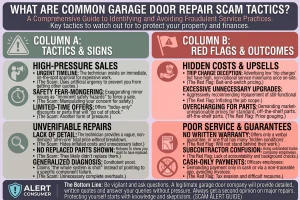

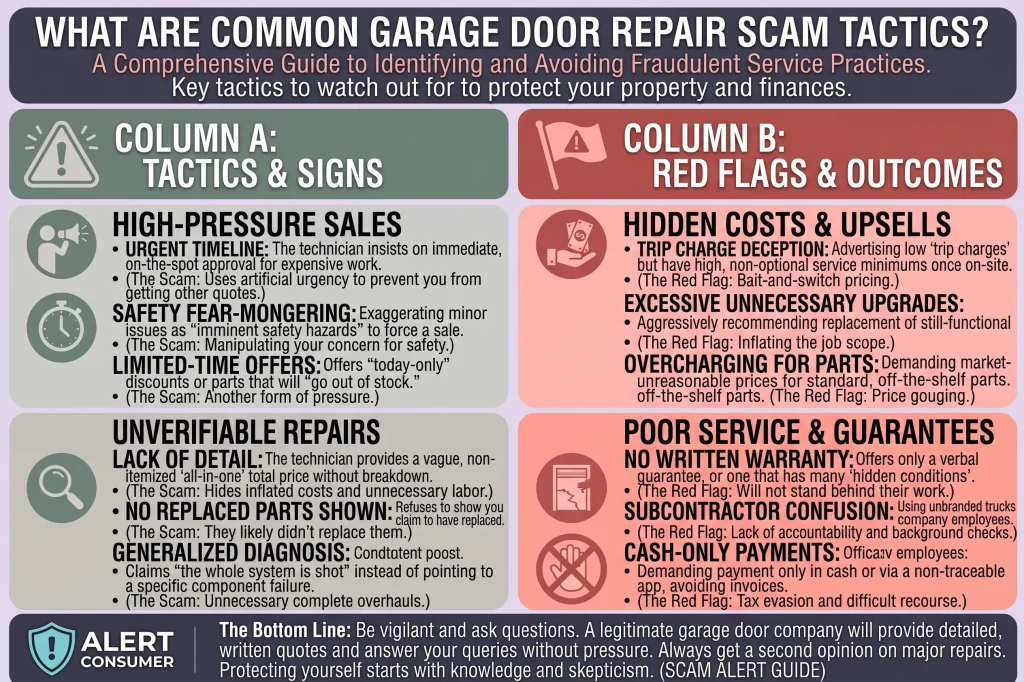
Dishonest operators rely on a small set of repeated tactics to turn a routine garage door repair into an inflated, unnecessary bill that never should have grown that large. Watching for these patterns early gives homeowners the chance to stop a scam before any money changes hands or a technician leaves the driveway.
Five tactics account for most reported cases involving garage door repair fraud across the country, regardless of the company’s size or how professional the pitch sounds. This guide breaks down how each one works, why it succeeds so often, and what a homeowner can do to avoid falling for it entirely, starting with the very first phone call.
Key Takeaways
- Fake urgency pushes homeowners into decisions before they can verify a company.
- Bait-and-switch pricing uses a low advertised fee to generate the initial call.
- Unnecessary parts often get bundled into a diagnosis that was never accurate.
- Fake or unverifiable companies rely on a polished website to appear legitimate.
- Cash-only payment demands remove any option to dispute charges later.
What Tactics Do Scammers Use Most Often?
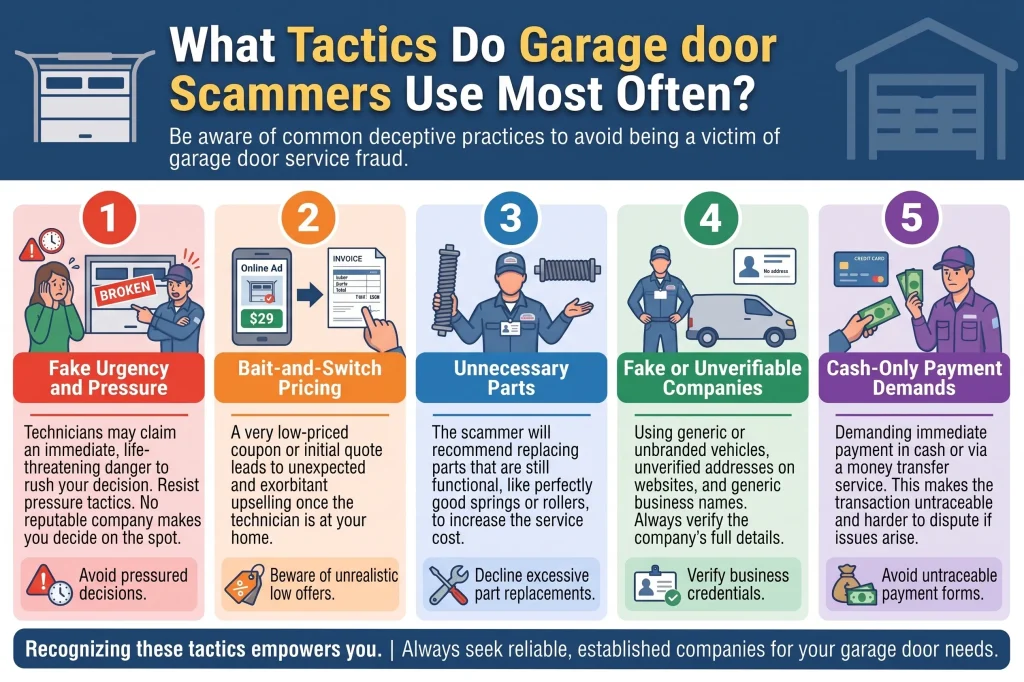
Trust breaks down the moment a homeowner stops asking questions and starts assuming good faith, especially once a stranger is already standing in the driveway.
| Tactic | What Happens | Why It Works |
| Fake Urgency and Pressure | A technician insists the repair cannot wait, even briefly | Fear shortens the time available to question a diagnosis |
| Bait-and-Switch Pricing | A low advertised fee climbs sharply once work begins | The low number removes hesitation before scheduling |
| Unnecessary Parts | Working components get replaced alongside the actual issue | A bundled diagnosis makes a simple fix look urgent |
| Fake or Unverifiable Companies | A polished website hides an unregistered or out-of-area operation | A professional online presence reads as trustworthy by default |
| Cash-Only Payment Demands | Payment gets requested with no receipt or traceable record | Untraceable payment removes any option to dispute later |
Verifying one claim before agreeing to anything is often all it takes to avoid a much larger loss, and it rarely costs more than a short phone call.
Fake Urgency and Pressure Tactics
Warnings about safety shorten the time spent verifying a claim, often turning a routine issue into a fabricated garage door emergency.
These pressure tactics tend to repeat across reported cases:
- Insisting the door poses an immediate safety risk without evidence.
- Framing a second opinion as a waste of valuable time.
- Refusing to leave the property until a decision gets made.
- Claiming a discounted rate will not apply again later.
- Pushing approval before providing any written estimate.
Pausing for even a few minutes before responding to this pressure removes most of a scammer’s leverage, often exposing the whole approach for what it really is.
Bait-and-Switch Pricing
Repairs involving a garage door opener sometimes get quoted at an unusually low fee that exists only to generate the initial phone call.
This tactic tends to unfold in a specific, repeated order:
- Advertising an unusually low fee to attract the first call.
- Discovering additional problems only after arriving on-site.
- Presenting a new total with no itemized explanation.
- Framing the higher price as unavoidable given the situation.
- Discouraging any comparison against other repair providers.
To trace exactly how this pricing pattern moves from the first call to the final invoice and where it typically breaks down, read our guide on Red Flags That Appear in a Garage Door Repair Estimate, which breaks down every stage scammers rely on.
Unnecessary Parts and Inflated Diagnoses
Confirming the manufacturer specifications behind any replaced part helps homeowners see whether a bundled diagnosis actually holds up.
These signs tend to reveal an inflated diagnosis:
- A technician claims multiple parts failed during a single visit.
- No willingness to show the specific components described as damaged.
- Pressure to approve a full package before getting a second opinion.
- A price that increases substantially once the technician proposes extra work.
- Refusal to explain why several systems supposedly failed at once.
To confirm whether an inflated diagnosis actually holds up before paying for it, read our guide on The Importance of a Second Opinion on Garage Door Repair, which covers how a second technician protects against this tactic.
Fake or Unverifiable Companies
Checking the listed address against an independent business registry confirms whether an operation is real before scheduling service.
Operations faking legitimacy tend to expose themselves through:
- A business name that sounds interchangeable with dozens of others.
- No verifiable physical address separate from a listed service area.
- Reviews concentrated in a short window instead of spread over time.
- Technicians who cannot confirm which branch dispatched them.
- Vehicles with no visible company branding or signage.
To decide when a company’s evasiveness has crossed the line into a red flag worth ending the conversation over, read our guide on When Is It Time to Walk Away From a Repair Offer?, which covers the clearest warning signs worth checking.
Cash-Only or Untraceable Payment Demands
Disputes, chargebacks, and any record tying an operator to the job all disappear once payment happens through untraceable means.
Payment demands during a scam tend to follow this pattern:
- Refusing credit card payment once the repair is complete.
- Requesting cash or a wire transfer with no receipt provided.
- Avoiding any invoice that names the business or technician.
- Pressuring payment before a final walkthrough of the work.
- Discouraging any request for a formal payment record.
Repair companies unwilling to accept any traceable payment method at all are not worth trusting with a larger job.
How Can Homeowners Protect Themselves From These Tactics?
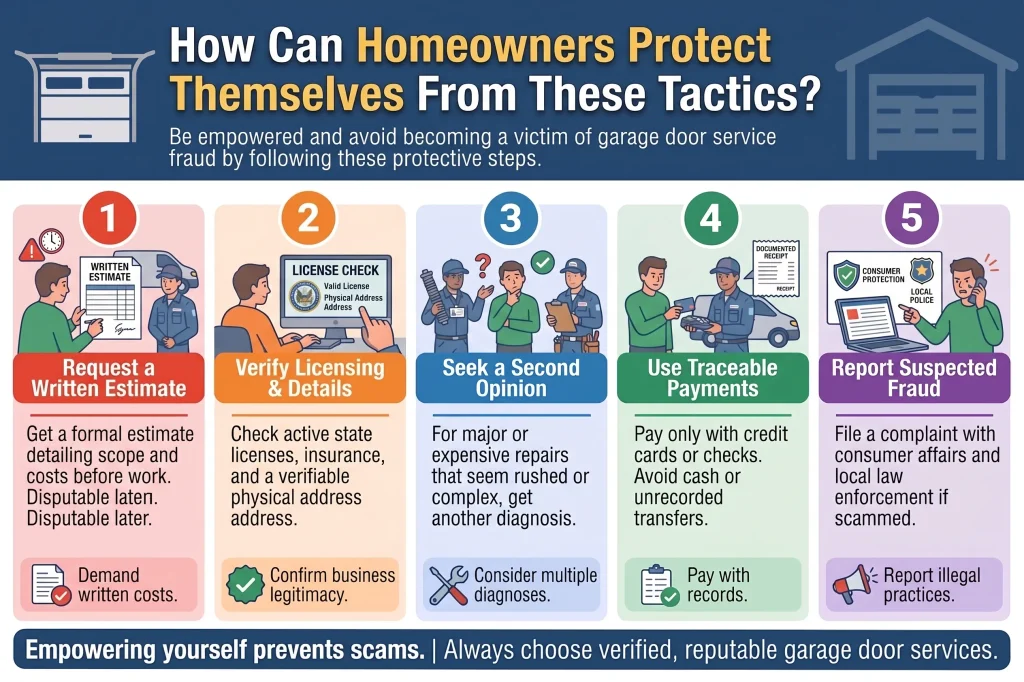
Standing precautions matter most before a technician ever arrives on-site, whether the job involves garage door installation or a smaller repair.
Few habits protect against nearly every tactic on this list:
- Requesting a written estimate before approving any repair work.
- Verifying licensing, insurance, and a physical business address.
- Getting a second opinion for any diagnosis that feels rushed.
- Paying only through traceable methods with a documented receipt.
- Reporting suspected fraud to local authorities or consumer protection agencies.
Building these habits into every repair decision removes most of the leverage a scammer depends on to succeed.
Knowing These Tactics Is the First Step Toward Avoiding Them
Dishonest operators count on one advantage above all else: a homeowner who does not know enough to question what is happening in the moment. Closing that gap through verification and patience turns a high-pressure situation into a manageable one, with far less financial exposure on the other side.
MF Solutions stands beside homeowners throughout Niles, Illinois with clear explanations instead of pressure or rushed decisions to close a job. Contact us or give us a call today, and let our trained team earn trust through transparency instead of urgency, from the very first phone call.
Frequently Asked Questions
How can homeowners confirm a technician is legitimate?
Requesting identification and confirming the technician represents the company named on the estimate usually resolves any doubt quickly, whether the visit involves garage door opener repair or something smaller. A technician who resists this simple request deserves added scrutiny before any work begins.
Why do scammers avoid accepting credit card payments?
Credit card payments create a dispute path if the work turns out to be unnecessary or overpriced, which most bad actors want to avoid. Cash or wire transfers remove that protection for the paying homeowner.
Does refusing an urgent repair on the spot cause more damage?
Waiting a short time for a second opinion rarely worsens a mechanical problem, despite pressure suggesting otherwise. Genuine emergencies involving a broken spring or a garage door spring repair gone wrong are far less common than technicians claim during a sales pitch.
What should a homeowner ask before approving a rushed repair?
Asking for a written estimate, proof of insurance, and an explanation of the specific parts involved covers most of what a legitimate company should provide without hesitation, especially for a bigger job like a new installation. Vague answers to these questions are worth taking seriously.
How do fraudulent operators use fear to close a sale faster?
Warnings about safety, liability, or worsening damage shorten the time a homeowner spends verifying a claim before approving payment, even when the parts in question are still perfectly durable. Checking a company's standing with a consumer protection agency in advance makes this pressure easier to resist.
Can a legitimate company still charge more for emergency service?
Emergency garage door repair services often cost more than routine work, and that alone does not indicate fraud, even for something as significant as a new garage door. Fair pricing should still come with a detailed estimate and a clear explanation before any work begins.
Is it reasonable to request a second technician's opinion during an emergency?
Calling a second company for a comparison quote is reasonable even during an urgent situation, since most garage door openers, sensors, and hardware issues can wait for a phone call. A provider who discourages this request deserves caution.
What documentation should a homeowner keep after a repair?
Keeping the invoice, technician's name, and any photos taken before and after the repair protects a homeowner if a dispute arises later, offering peace of mind if questions come up down the line. This documentation also supports a report to local authorities if needed.
Are cash-only demands ever legitimate for emergency service?
A cash preference alone does not confirm fraud, but a strong refusal to accept any traceable method is a pattern worth questioning over time, no matter how simple the moving parts involved seem. Requesting a card payment option first is a simple way to see how a company responds.