
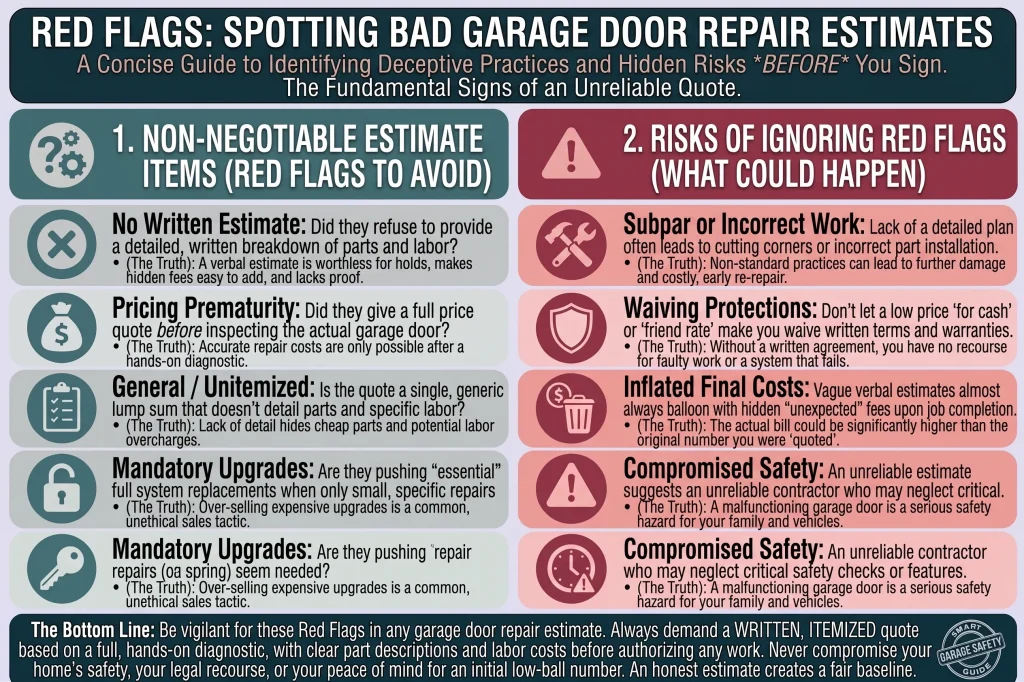
Written garage door repair estimates should explain every cost clearly and completely, without vague terms or pressure to sign before reading it fully. Warning signs repeat across estimates tied to overcharging or outright fraud, and identifying them early protects against a much larger bill down the road.
Six specific patterns show up most often in estimates worth questioning before approval, regardless of how established or professional the company appears. This guide breaks down what each red flag looks like, why it matters, and how to respond once one appears, so nothing gets signed under pressure.
Key Takeaways
- Vague line items without specific parts or prices deserve a second look.
- Extremely low quotes often signal hidden fees added once work begins.
- Cash-only demands remove any option to dispute charges after the fact.
- High-pressure tactics rely on fear to rush a decision before comparison.
- Torsion spring claims sometimes recommend replacing parts that still work.
What Red Flags Should Homeowners Watch For in an Estimate?
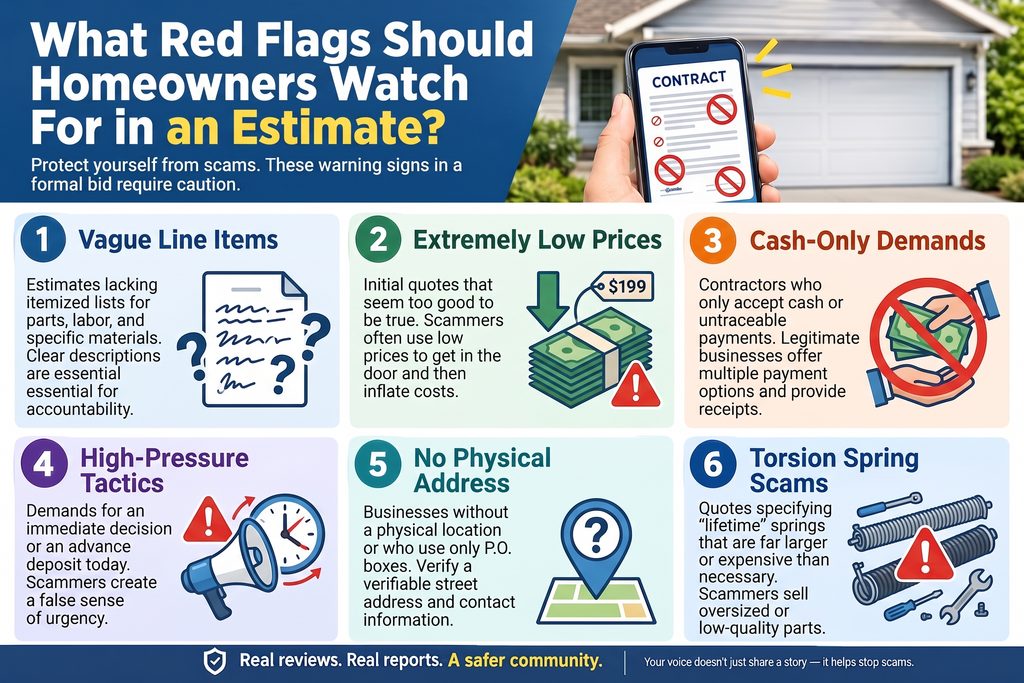
Fraudulent operators lean on the same handful of tricks because homeowners rarely compare notes with anyone else before paying for garage door work.
| Red Flag | What It Looks Like | Why It Matters |
| Vague Line Items | Charges listed as “misc parts” or “repair service” | Makes it impossible to verify what is actually being paid for |
| Extremely Low Prices | A quote far below typical cost for the same job | Often signals hidden fees or poor-quality parts added later |
| Cash-Only Demands | Refusal to accept checks, cards, or digital payments | Removes any traceable record if a dispute happens later |
| High-Pressure Tactics | Claims the door will fail today without immediate approval | Fear shortens the time available to question the diagnosis |
| No Physical Address | Only a mobile number listed, no verifiable office location | Signals an operation with no real local accountability |
| Torsion Spring Scams | Claims both springs need replacement when only one failed | Springs typically share a lifespan, but not always at once |
Trust in any estimate should come from what gets written down, not from how convincing the person delivering it sounds.
Vague Line Items
Charges listed only as “misc parts” or generic door repair leave no way to verify what the money actually paid for, no matter how small the job.
These vague patterns tend to repeat across questionable estimates:
- No specific part names listed anywhere on the invoice.
- A single lump-sum total with no labor or parts breakdown.
- Generic descriptions like “hardware” instead of the actual component.
- No brand or model number listed for any replaced part.
- Refusal to itemize the estimate when asked directly.
Requesting a fully itemized breakdown before approving anything removes this ambiguity entirely and gives both sides something concrete to reference later.
Extremely Low Prices
Quotes involving garage door replacement priced far below typical cost for the same job, even for a full new garage door, often signal hidden fees waiting to surface later.
These pricing patterns tend to reveal themselves in a specific order:
- An unusually low quote advertised to generate the first phone call.
- Additional charges discovered only after arriving on-site.
- A price that climbs sharply once the technician begins work.
- Demands for full payment upfront before any parts arrive.
- No willingness to explain why the final total changed.
To weigh this pricing pattern against a second, independent number before approving anything, read our guide on The Importance of a Second Opinion on Garage Door Repair, which covers how that comparison protects against inflated totals.
Cash-Only Demands
Comparing a payment request against standard payment practices that legitimate repair companies typically follow reveals how unusual cash-only demands actually are.
These payment red flags tend to show up together:
- Refusing checks, credit cards, or digital payment options entirely.
- Requesting the full amount before any work begins.
- Avoiding any invoice that names the business or technician.
- Pressuring payment before a final walkthrough of the repair.
- Discouraging any request for a formal payment record.
Companies unwilling to accept any traceable payment method deserve real hesitation before signing anything at all, especially on a larger repair job.
High-Pressure Tactics
Claims that a door will collapse today often frame a routine issue as one of several fabricated garage door emergencies instead of a smaller, targeted fix.
These pressure tactics tend to repeat across reported estimates:
- Insisting the door poses an immediate safety risk without evidence.
- Framing a second opinion as a waste of valuable time.
- Refusing to leave the property until a decision gets made.
- Pushing a full replacement instead of a smaller, targeted repair.
- Discouraging any comparison against other repair companies.
To trace exactly how this tactic connects to a broader pattern used across the industry, read our guide on What Are Common Garage Door Repair Scam Tactics?, which breaks down why urgency works so well on an unprepared homeowner.
No Physical Address
Checking a company’s listed contact information against an independent business registry confirms whether a real local office actually exists.
Operations with no verifiable address tend to expose themselves through:
- A mobile phone number listed with no landline or office extension.
- No website address separate from a generic listing service.
- Reviews concentrated in a short window instead of spread over time.
- Technicians who cannot confirm which office dispatched them.
- Business cards missing any physical address entirely.
Confirming a real address before scheduling service protects against a company with no actual accountability, even if the pricing looks reasonable at first.
Torsion Spring Scams
Garage door torsion spring repair sometimes gets inflated into a two-spring replacement when only one spring actually failed.
These spring-related claims tend to follow a familiar pattern:
- Insisting both springs must get replaced, even with one intact.
- Refusing to show the specific spring described as damaged.
- Claiming a matched pair prevents future failure, without evidence.
- Charging premium pricing for hardware that shows no visible wear, despite the parts being genuinely durable.
- Pressuring approval before a second technician can inspect the springs, a step any honest garage door spring repair should welcome.
To decide when a spring-replacement estimate has crossed into territory worth walking away from entirely, read our guide on When Is It Time to Walk Away From a Repair Offer?, which covers the clearest signs worth checking first.
What Should Homeowners Do When an Estimate Raises Concerns?
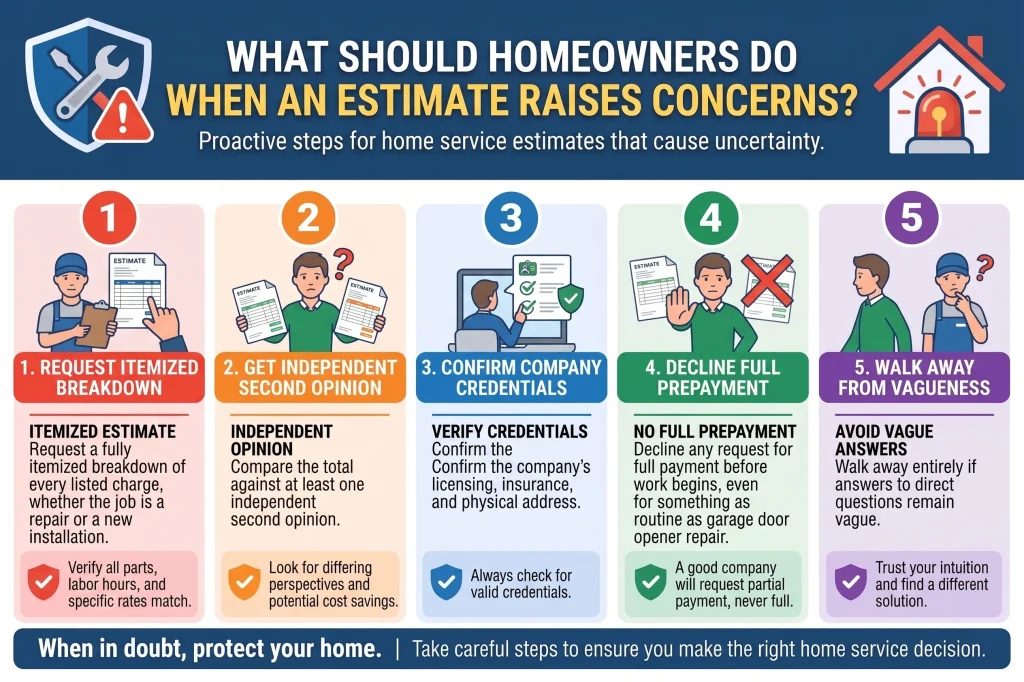
Estimates involving garage door installation deserve the same careful review as any smaller repair before signing anything.
Few steps help once an estimate raises a red flag:
- Request a fully itemized breakdown of every listed charge, whether the job is a repair or a new installation.
- Compare the total against at least one independent second opinion.
- Confirm the company’s licensing, insurance, and physical address.
- Decline any request for full payment before work begins, even for something as routine as garage door opener repair.
- Walk away entirely if answers to direct questions remain vague.
Responding calmly to a questionable estimate brings genuine peace of mind, even when the pressure to decide quickly feels intense.
A Careful Read of the Estimate Protects Every Repair Decision
Fraudulent operators depend on homeowners accepting a total without reading the details closely enough to question anything written on it. Reading every line, asking direct questions, and comparing the total against a second source closes that gap entirely, before any money changes hands.
MF Solutions provides homeowners throughout Niles, Illinois with fully itemized estimates before any repair work begins, no matter how small the job seems. Contact us or give us a call today, and let our trained team explain every line before asking for approval, so nothing gets signed without understanding it first.
Frequently Asked Questions
What should an itemized estimate actually include?
An itemized estimate should list each specific part, its individual cost, and the labor charge separately from materials. Missing any of these details makes it difficult to verify the final invoice later.
Does refusing cash-only payment ever damage a relationship with a company?
Requesting a traceable payment method is a completely reasonable request that a legitimate company should accommodate without hesitation. A company unwilling to offer any alternative deserves added scrutiny before approval.
How can homeowners tell if urgency is real or manufactured?
Genuine emergencies involving a broken spring or a jammed track are far less common than technicians claim during a rushed sales pitch. Requesting a second opinion rarely worsens a situation that feels urgent but is not.
Is it normal for an estimate to change after a technician arrives?
Minor adjustments sometimes happen once a technician inspects the moving parts directly, but a significant increase deserves a clear explanation. A company unwilling to justify the change in writing is worth questioning further.
Why do scammers specifically target torsion springs?
Springs handle most of a garage door's weight, making them an easy component to claim as failed without visible proof. Requesting to see the damaged spring directly usually reveals whether the claim holds up.
Can a homeowner request proof of licensing before approving an estimate?
Requesting proof of a current, valid contractor license is a reasonable ask before approving any repair work. A company confident in its standing typically provides this documentation without delay.
Does a missing physical address always indicate a scam?
Some legitimate technicians operate as mobile services without a traditional storefront, which does not automatically indicate fraud. Confirming licensing, insurance, and a business registration still matters regardless of storefront presence.
What should a homeowner do if pressured to sign on the spot?
Declining to sign anything without time to review the estimate protects against approving charges under pressure. A legitimate company should welcome this pause rather than push back against it.
How does comparing multiple estimates help avoid these red flags?
Comparing at least two estimates for the same repair, whether it involves garage door openers with faulty sensors or a full replacement, usually reveals whether pricing stays consistent between companies. A significant gap between the two numbers is worth investigating before approving either one.